Trainertext Magic
So what is trainertext?
We teach the children a single image for each sound used in words (the “phonemes”). We then place those images above the text. We call them “pictophones”.
So now, the child can decode any word. As soon as the letters are a bit confusing, the images above are there to guide them through it. And in English, that can be pretty useful!

The pictophone characters above are the moose with a juice, the Oon on the moon, the vulture into culture, the lion with a tie on, the umbrella man with a suntan, the kangaroos reading the news and the ogre in a toga.
The key thing is how the sound represented by the letter O is given away by the three different pictophones above it.
Here is the version we use for older learners in Reading Copilot:

It only takes minutes to learn the phoneme-image relationship of each ‘pictophone’. Then those moments of frustration and failure are now turned into a mini triumphs. The impact on the child’s psychology is huge.
You can test it yourself with this bit of English written with Greek letters. The pictophones used are the heart, ear, intestine, zigzag, six, umbrella, moon, eight, nine, earth, tie, egg, key/six, unicorn, nine/gate, voiced three, ring, equals, apple, leg, four, bell:
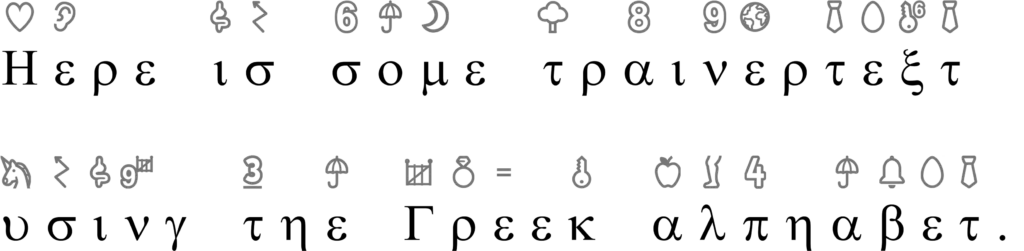
Neat, isn’t it? Can you see how quickly you would get the hang of the Greek letters if you did a bit of this each day. Read back through the sentence and it will already seem easier.
It means the children can learn to read in the same way they learned to walk, talk and play with a ball. It is the way our brains are wired to learn.
Here is a video of a girl aged 7 who had previously struggled to read for several years on an alternative system:
Evidence
In a 2014 Open University Research Study with 90 students who were two years behind, all bar one caught up with their peers within 120 short Easyread sessions. Here is a short executive summary of the results.
Since its launch in 2022, the mainstream schools making full use of the All Aboard Phonics curriculum expect to see all their students reading confidently by the age of 7. Even the SEND settings have seen their students building a new level of confidence.
We have been running Reading Copilot trials since April 2025 and the average catchup has been over a year of reading age per month of intervention.
The Facebook Reviews for the Easyread System are 100% positive. You can read the hundreds of stories of turnarounds there.
Spelling
The hidden extra is that you will find that spelling development also follows naturally, without needing spelling practice lists.
Trainertext Resources
All our literacy systems use trainertext. So take your pick:
– All Aboard Phonics for early years classrooms.
– Reading Copilot for school interventions.
– The Easyread System for home solutions.